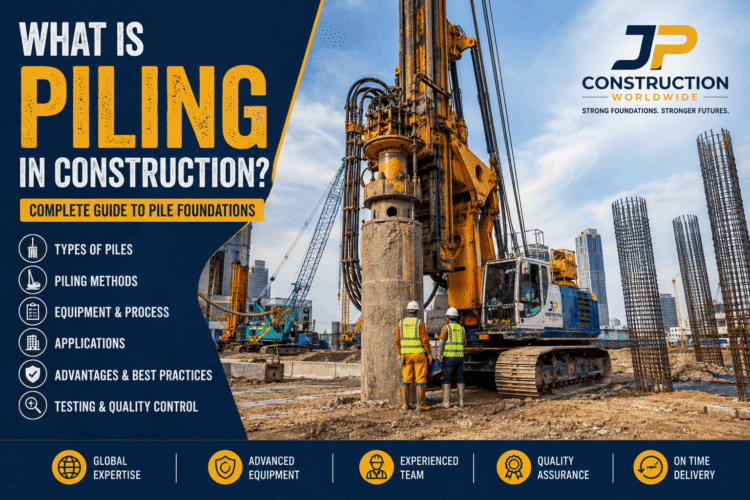
Piling in construction is a deep foundation technique used to transfer the load of a building, bridge, industrial structure, tower, or other heavy structure safely into deeper and stronger layers of soil or rock.
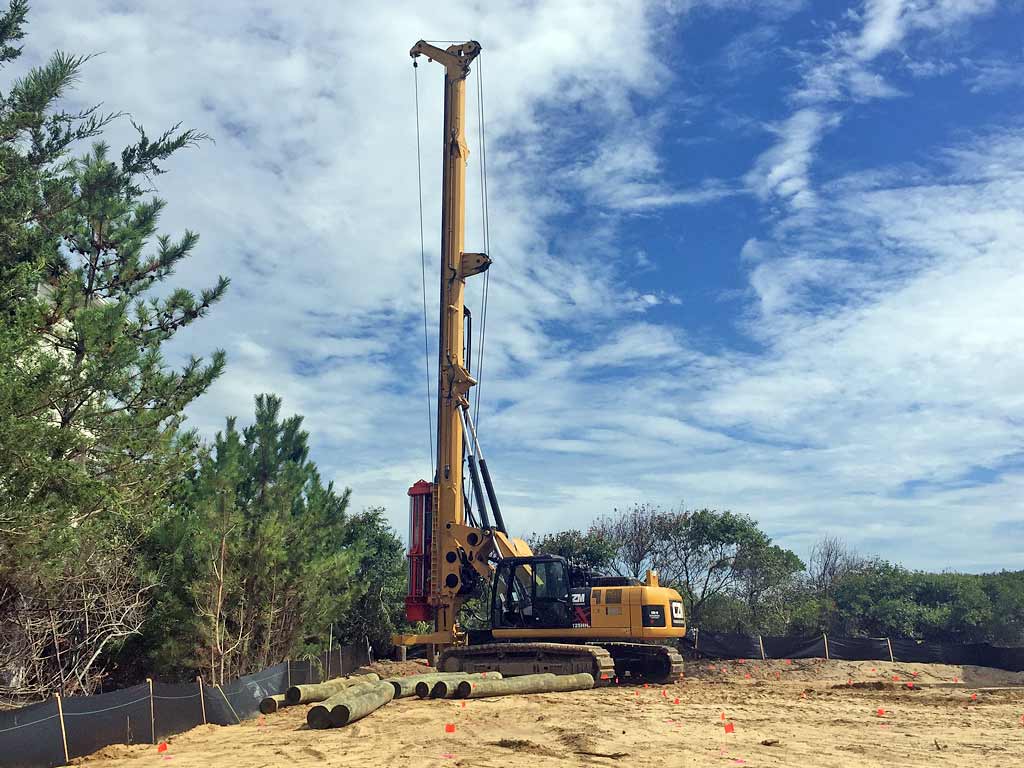
When the upper soil is weak, compressible, waterlogged, or unable to support the required structural load, pile foundations provide a reliable solution by transferring loads to deeper, stronger strata.
In this complete guide, we explain what piling is, why pile foundations are required, different types of piles, piling methods, equipment, applications, advantages, and important factors to consider when selecting a piling contractor.
JP Construction provides professional piling and foundation construction services for infrastructure, commercial, industrial, residential, power, railway, highway, bridge, and other major construction projects.
What Is Piling in Construction?
Piling is a type of deep foundation construction in which long structural elements called piles are installed deep into the ground.
The piles transfer structural loads from the foundation to suitable soil or rock strata below the ground surface.
Unlike shallow foundations, which transfer loads relatively close to the surface, pile foundations can extend several metres or even tens of metres below ground depending on:
- Soil conditions
- Structural load
- Groundwater level
- Pile diameter
- Required pile capacity
- Geological conditions
- Building or infrastructure design
- Seismic requirements
Piles can be made from reinforced concrete, steel, timber, or composite materials, depending on the project requirements.
Why Is Piling Required?
Not every construction project requires piles. Piling becomes necessary when conventional shallow foundations cannot safely support the proposed structure.
Common reasons for using pile foundations include:
1. Weak Surface Soil
If the upper layers of soil have insufficient bearing capacity, piles can transfer loads to deeper and stronger strata.
2. Heavy Structural Loads
High-rise buildings, bridges, power plants, industrial facilities, towers, and large infrastructure projects can generate substantial foundation loads.
3. High Water Table
Groundwater conditions can make conventional excavation and shallow foundation construction difficult.
4. Settlement Control
Pile foundations can help control excessive settlement where surface soils are compressible.
5. Scour Conditions
Bridge foundations and marine structures may require deep foundations because soil around the foundation can be removed by flowing water.
6. Challenging Ground Conditions
Rock, soft clay, loose sand, filled ground, and variable geological strata may require specialized piling solutions.
How Does a Pile Foundation Work?
A pile foundation transfers load through one or both of two primary mechanisms:
1. End-Bearing Piles
An end-bearing pile transfers most of its load through the bottom tip of the pile to a strong soil layer or rock.
Load path:
Structure → Pile Cap → Pile → Strong Stratum/Rock
This type of pile is particularly useful when a strong bearing layer exists at a practical depth.
2. Friction Piles
A friction pile transfers structural load through friction or adhesion developed between the pile surface and surrounding soil.
Load path:
Structure → Pile Cap → Pile → Surrounding Soil
Friction piles are commonly used where a suitable hard bearing stratum is very deep or where load transfer through the surrounding soil is appropriate.
In many real projects, piles develop a combination of end bearing and shaft resistance.
Main Types of Piles Used in Construction
Pile foundations can be classified according to material, installation method, structural function, and load-transfer mechanism.
1. Bored Cast-in-Situ Concrete Piles
Bored piles are constructed by drilling or boring a hole into the ground and then placing reinforcement and concrete.
Typical sequence:
- Setting out pile location
- Positioning the piling rig
- Drilling the bore
- Stabilizing the borehole
- Installing reinforcement cage
- Installing temporary/permanent liner where required
- Concreting the pile
- Removing temporary casing if applicable
- Pile testing
Bored cast-in-situ piles are widely used for buildings, bridges, industrial structures, towers, power projects, and infrastructure.
2. DMC Piling
DMC piling, commonly referred to as Direct Mud Circulation piling, uses drilling fluid to stabilize the borehole during drilling.
DMC piling is particularly useful where the borehole requires stabilization because of loose or unstable soil conditions.
A drilling fluid circulates through the borehole while the soil is excavated.
DMC piling is widely used in:
- Building foundations
- Industrial projects
- Infrastructure
- Bridges
- Commercial developments
- Power projects
3. Hydraulic Rotary Piling
Hydraulic rotary piling rigs use hydraulic-powered rotary drilling systems to construct bored piles.
These rigs can be used for different pile diameters and depths depending on the machine configuration and ground conditions.
Hydraulic piling rigs are commonly used for:
- Large foundation projects
- High-rise buildings
- Bridges
- Industrial structures
- Power plants
- Infrastructure projects
4. Driven Piles
Driven piles are installed by driving prefabricated piles into the ground using equipment such as hydraulic or diesel pile hammers.
Common driven pile materials include:
- Steel
- Precast concrete
- Timber
Driven piling can provide high productivity, but vibration and noise must be considered, particularly in densely populated areas.
5. Steel Piles
Steel piles can be manufactured in various forms, including:
- H-piles
- Pipe piles
- Tubular piles
- Sheet piles
Steel piles are often selected for projects requiring high structural capacity or specific installation characteristics.
6. Precast Concrete Piles
Precast concrete piles are manufactured before being transported to the construction site.
They are then driven or installed using suitable piling equipment.
Their controlled manufacturing environment can provide consistent quality, although transportation and handling requirements must be considered.
7. Micropiles
Micropiles are small-diameter deep foundation elements generally used where access is restricted or where conventional piling equipment cannot be used effectively.
Typical applications include:
- Foundation strengthening
- Underpinning
- Restricted-access construction
- Retrofit projects
- Slope stabilization
- Existing building support
Piling Methods Used Around the World
The appropriate piling method depends heavily on ground conditions, pile diameter, depth, structural load, site access, groundwater, environmental restrictions, and project specifications.
Common piling methods include:
Bored Piling
A hole is drilled into the ground and filled with reinforcement and concrete.
DMC Piling
Drilling is carried out using a circulating drilling fluid to stabilize the bore.
Rotary Drilling
A rotary drilling system excavates the soil using drilling tools attached to a piling rig.
Driven Piling
Prefabricated piles are driven into the ground using a pile hammer.
CFA Piling
Continuous Flight Auger piling uses a continuous auger to drill the pile before concrete is placed through the hollow stem.
Manual or Small-Rig Piling
Specialized small equipment or manual methods may be used for locations with restricted access, subject to engineering requirements.
Piling Construction Process
A typical bored pile construction process involves several important stages.
Step 1: Site Investigation
Before piling starts, a geotechnical investigation should establish:
- Soil profile
- Groundwater level
- Rock depth
- Soil strength
- Bearing capacity
- Potential obstructions
- Settlement characteristics
A proper geotechnical investigation is fundamental to selecting an appropriate pile system.
Step 2: Pile Setting Out
The pile coordinates are transferred from the approved foundation drawings to the site.
Accuracy is critical because incorrect pile positioning can affect pile caps and the structural system.
Step 3: Piling Rig Positioning
The piling rig is positioned over the pile location.
The rig must be properly aligned and stabilized before drilling begins.
Step 4: Drilling
The drilling tool excavates the soil to the specified pile depth.
Different drilling tools may be selected depending on soil and rock conditions.
Step 5: Temporary Casing or Liner
Where required, a temporary casing or liner may be installed to prevent borehole collapse.
Casing requirements depend on:
- Soil stability
- Groundwater
- Bore depth
- Pile diameter
- Site conditions
Step 6: Bore Cleaning
The pile bore must be cleaned properly before reinforcement and concrete placement.
Excessive loose material at the bottom of the bore can affect pile performance.
Step 7: Reinforcement Cage Installation
The fabricated reinforcement cage is carefully lowered into the pile bore.
Proper cover, cage dimensions, spacers, lap lengths, and reinforcement details must comply with the approved structural drawings.
Step 8: Concreting
Concrete is placed into the pile using an appropriate method.
For piles constructed below groundwater or using drilling fluid, tremie concreting may be required.
Continuous and controlled concrete placement is important to maintain pile integrity.
Step 9: Pile Head Treatment
After concrete reaches the required strength, the pile head is treated and prepared for connection with the pile cap or foundation structure.
Step 10: Pile Testing
Pile testing is carried out according to the project specifications and applicable standards.
Testing may include:
- Initial load tests
- Routine load tests
- Compression load tests
- Tension load tests
- Lateral load tests
- Pile integrity tests
- Cross-hole sonic logging, where specified
Piling Equipment
Modern piling projects use specialized heavy equipment.
Common equipment includes:
- Hydraulic piling rigs
- Rotary drilling rigs
- DMC rigs
- CFA piling rigs
- Pile hammers
- Casing oscillators
- Temporary casing systems
- Mud pumps
- Desanders
- Concrete pumps
- Tremie pipes
- Welding machines
- Reinforcement cage fabrication equipment
- Excavators
- Cranes
- Generators
- Air compressors
The equipment should be selected based on the pile diameter, required depth, soil conditions, site accessibility, and production requirements.
What Is a Piling Rig?
A piling rig is specialized construction equipment used to install piles into the ground.
Depending on its design, a piling rig can perform activities such as:
- Drilling
- Rotary excavation
- Casing installation
- Augering
- Pile construction
- Rock drilling
Hydraulic rotary piling rigs are widely used for bored cast-in-situ pile construction.
The correct rig selection can significantly influence project productivity and cost.
Applications of Piling
Pile foundations are used across many sectors worldwide.
Buildings
- High-rise buildings
- Commercial complexes
- Residential towers
- Hospitals
- Educational institutions
- Shopping malls
Infrastructure
- Bridges
- Flyovers
- Highways
- Railways
- Metro projects
- Airports
Industrial Construction
- Factories
- Warehouses
- Manufacturing plants
- Process facilities
- Industrial structures
Power & Energy
- Power plants
- Substations
- Transmission infrastructure
- Solar projects
- Renewable energy projects
Telecommunications
- Telecom towers
- Monopoles
- Communication infrastructure
Water & Marine Structures
- Ports
- Jetties
- River structures
- Water treatment facilities
- Marine infrastructure
Advantages of Pile Foundations
Pile foundations offer several advantages when correctly designed and installed.
High Load Capacity
Deep foundations can support substantial structural loads.
Reduced Settlement
Piles can reduce the effects of weak surface soils and excessive settlement.
Suitable for Difficult Ground
Specialized piling methods can be used in challenging geological conditions.
Suitable for Heavy Structures
Piling is widely used for bridges, towers, industrial plants, high-rise buildings, and infrastructure.
Flexible Construction Methods
Different pile systems can be selected depending on the project requirements.
Factors Affecting Piling Cost
The cost of piling varies significantly from one project to another.
Important cost factors include:
- Pile diameter
- Pile depth
- Number of piles
- Soil and rock conditions
- Groundwater
- Reinforcement quantity
- Concrete grade and quantity
- Temporary casing requirements
- Piling rig type
- Site accessibility
- Mobilization and demobilization
- Working hours
- Pile testing requirements
- Transportation
- Environmental restrictions
Therefore, a piling contractor should generally inspect the project conditions and review the approved drawings and geotechnical report before providing a final commercial offer.
How to Select a Piling Contractor
Choosing the right piling contractor is critical because foundation defects can have serious structural and financial consequences.
Before appointing a contractor, consider:
Experience
Check experience with similar pile diameters, depths, soil conditions, and project types.
Equipment
Confirm that the contractor has suitable piling rigs and supporting equipment.
Technical Team
A capable technical team should understand drilling, reinforcement, concreting, testing, and quality control.
Safety
The contractor should maintain appropriate site safety procedures.
Quality Control
Review procedures for bore inspection, concrete quality, reinforcement cages, pile records, and testing.
Project Capacity
Ensure that the contractor can mobilize sufficient manpower and equipment to meet the required production rate.
Quality Control in Piling
Quality control should be maintained throughout the piling process.
Important records can include:
- Pile location
- Pile diameter
- Pile depth
- Drilling time
- Soil strata
- Bore condition
- Casing depth
- Reinforcement cage details
- Concrete quantity
- Concrete grade
- Tremie records
- Cut-off level
- Testing results
A proper pile installation record or pile log should be maintained for every pile.
Common Problems in Piling
Piling operations can encounter several challenges.
Borehole Collapse
Unstable soil can cause the borehole to collapse.
Possible solutions: appropriate casing, drilling fluid, and suitable drilling procedures.
Excessive Groundwater
High groundwater can complicate drilling and concreting.
Possible solutions: suitable casing, drilling fluid, and controlled concreting methods.
Difficult Soil or Rock
Hard strata can reduce drilling productivity.
Possible solutions: suitable drilling tools, rock augers, core barrels, or specialized equipment.
Cage Installation Problems
An improperly fabricated or installed reinforcement cage can create quality issues.
Solution: inspect cage dimensions, lifting points, spacers, and reinforcement before installation.
Concrete Defects
Poor concrete placement can compromise pile integrity.
Solution: controlled concrete supply, appropriate tremie procedures, and continuous monitoring.
Pile Testing
Pile testing provides information about pile performance and integrity.
Depending on the project specification, testing may include:
Static Load Test
Used to evaluate pile behavior under applied load.
Dynamic Load Test
Uses dynamic measurements to assess pile capacity and installation response.
Pile Integrity Test
Helps identify potential anomalies in the pile shaft.
Lateral Load Test
Evaluates pile performance under horizontal loading.
Pull-Out/Tension Test
Used where piles are subjected to tensile forces.
Testing requirements should always follow the approved design, project specifications, and applicable engineering standards.
Piling vs. Shallow Foundation
| Feature | Pile Foundation | Shallow Foundation |
|---|---|---|
| Foundation depth | Deep | Relatively shallow |
| Load transfer | Deep strata + shaft resistance | Near-surface soil |
| Suitable for weak surface soil | Often suitable | May not be suitable |
| Heavy structures | Highly suitable | Depends on soil capacity |
| Construction equipment | Specialized equipment generally required | Usually simpler |
| Cost | Generally higher | Generally lower |
| Settlement control | Can be advantageous | Depends strongly on soil |
The final foundation system should always be selected by qualified geotechnical and structural engineers.
Piling for Infrastructure Projects
Modern infrastructure development increasingly requires reliable deep foundation solutions.
Piling is extensively used in:
- National highways
- Railway infrastructure
- Metro systems
- Bridges
- Airports
- Hospitals
- Industrial corridors
- Power projects
- Renewable energy projects
- Urban infrastructure
Large infrastructure projects often require hundreds or thousands of piles, making production planning, equipment availability, quality control, and experienced execution extremely important.
Why Choose JP Construction for Piling Services?
JP Construction is a piling and foundation construction contractor providing specialized piling solutions for construction and infrastructure projects.
Our capabilities include:
- Hydraulic Rig Piling
- DMC Piling
- TMR Piling
- Tractor Piling
- Manual Auger Piling
- Pile Load Testing
- Monopole Foundation
- High Mast Foundation
- Steel Cage Fabrication
- Liner Rolling and Installation
- Foundation Construction Support
JP Construction works with project requirements ranging from commercial and industrial construction to infrastructure, power, tower, bridge, and other foundation applications.
We focus on safe execution, quality control, technical coordination, productivity, and timely project completion.
Frequently Asked Questions About Piling
What is piling in construction?
Piling is a deep foundation technique where piles are installed into the ground to transfer structural loads to deeper soil or rock strata.
Why are piles used?
Piles are used when near-surface soil cannot safely support the required structural load or when settlement and ground conditions make shallow foundations unsuitable.
What is the difference between bored and driven piles?
Bored piles are constructed by drilling a hole and placing reinforcement and concrete, while driven piles are generally prefabricated elements installed by driving them into the ground.
How deep can piles be?
Pile depth depends on soil conditions, structural requirements, pile diameter, design criteria, and the depth of suitable bearing strata. There is no single standard depth for every project.
What is DMC piling?
DMC stands for Direct Mud Circulation. It is a drilling technique that uses circulating drilling fluid to help stabilize the borehole during pile construction.
What is a piling rig?
A piling rig is specialized equipment used to drill, install, or construct piles.
How much does piling cost?
Piling cost depends on pile diameter, depth, quantity, soil conditions, concrete, reinforcement, equipment, mobilization, testing, and site conditions. A project-specific quotation is required for an accurate price.
Is piling suitable for every building?
No. The foundation system should be selected based on structural design, geotechnical investigation, site conditions, and engineering requirements.
Conclusion
Piling is one of the most important deep foundation technologies used in modern construction. From high-rise buildings and bridges to industrial facilities, power plants, highways, hospitals, towers, and major infrastructure, pile foundations provide a solution where conventional shallow foundations may not be sufficient.
Successful piling depends on the right combination of geotechnical investigation, engineering design, piling method, equipment, skilled manpower, quality control, concrete placement, reinforcement, and pile testing.
If you are planning a construction project requiring bored piling, DMC piling, hydraulic piling, foundation work, monopole foundations, or other deep foundation services, working with an experienced piling contractor can significantly improve project execution and reliability.
Need Professional Piling Services?
JP Construction provides piling and foundation construction services for projects in India and supports opportunities for international construction and infrastructure requirements.
Website: www.jpconstruction.in
Email: info@jpconstruction.in
Phone: +91 8709668332
Contact JP Construction for piling, deep foundation, hydraulic rig piling, DMC piling, pile load testing, and foundation construction requirements.
Keywords:
- piling construction
- pile foundation
- piling contractor
- piling services
- piling work
- piling rig
- bored piling
- DMC piling
- hydraulic piling
- deep foundation
- pile foundation construction
- piling company
- foundation contractor
- pile testing
- construction piling
Global SEO Keywords:
- piling contractor India
- piling contractor worldwide
- international piling contractor
- foundation piling contractor
- deep foundation contractor
- bored piling contractor
- hydraulic piling contractor
- piling services India
- piling construction company
- commercial piling contractor
- industrial piling contractor
- infrastructure piling contractor